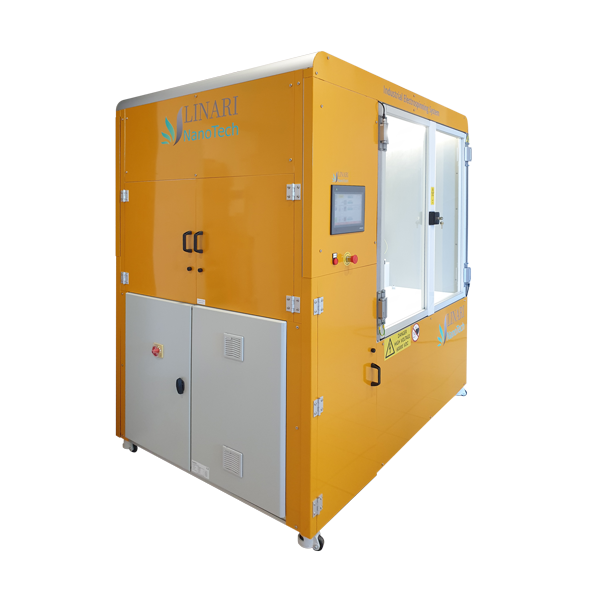


Pure Spinner – Bulk Production of Substrate-Free Nanofibers
Pure Spinner – Bulk Production of Substrate-Free Nanofibers
Shipping date: 27 Dec – 24 Jan
Pure Spinner produces nanofibers as a material, not as a coating. A horizontal-axis collector of up to 0.47 m², up to 140 needles, eight pumps and a digitally controlled blow spinning module — with no substrate to contaminate what you make.
Most pilot systems are built around a roll-to-roll web: the fibre is born attached to something. That is the right answer for coated media, and the wrong one if the fibre is the product.
If you are making nanofiber-based additives, inks, chopped fibres or fillers, a substrate is not a support — it is a source of release and contamination. Pure Spinner has no substrate by design.
0.47 m² of collection area
The largest drum is Ø250 × 600 mm: a collecting surface of 0.47 m². For comparison, the largest mandrel offered on competing laboratory and medical platforms is around Ø30 × 400 mm — roughly one twelfth of the area.
We publish the area rather than a production rate on purpose. Throughput in electrospinning depends on the polymer, the solvent, the concentration and the ambient conditions, so any number we printed would be true for one recipe and misleading for yours. Collection area is geometry: it holds whatever you spin.
Deposition that is uniform across the whole drum
The emitters translate along the full 600 mm of the drum at up to 1000 mm/s — a complete pass in six tenths of a second. While the drum turns once, the emitters have crossed it several times in both directions.
That overlap is what makes 0.47 m² a usable figure rather than a nominal one: the deposit is even along the axis, not concentrated in the middle where the needles happen to sit.
Aligned fibres too, when you need them
Collector speed spans 2000 rpm on small collectors down to 100 rpm on the largest drum, and what matters for fibre orientation is peripheral speed, not rpm.
- Small collectors at 2000 rpm reach 8.4 m/s on a Ø80 mm drum and over 10 m/s on Ø100 — fully in the regime where fibres are drawn and aligned, for oriented mats and tubular structures.
- The Ø250 mm drum at 100 rpm runs at about 1.3 m/s. That is deliberate: for bulk pure fibre you want an even, unstressed deposit over the largest possible area, not alignment — the material is processed and often chopped afterwards anyway.
One machine covers both, by changing the collector.
The collector is the product
Because the fibre is what you are selling, the collector is not a fixture — it is where quality is won or lost.
It is removable and extracted on a wheeled support, so nobody handles or touches the fibre during unloading. The loaded collector is then processed outside the machine — thermal treatment, chemical or physical steps chosen for the material — and the fibre is recovered there.
Collectors are made in different metals and can be coated, for example in titanium nitride (TiN). TiN is an unusually good answer here because it is two things at once: extremely hard, so the surface does not scratch or wear and releases essentially no particulate into the fibre; and electrically conductive, so it does not degrade the field the way an insulating protective coating would. Purity and process efficiency in the same surface.
Electrospinning, electro-blow spinning, and blow spinning without high voltage
The optional digitally controlled blow spinning module adds a gas flow that helps draw the jet. It raises throughput, and it lets you process solutions that will not open under electric field alone — more viscous, less conductive, or in solvents that resist electrospinning.
It also runs without high voltage at all, as pure solution blow spinning. That is not a variant of the same process: it is a second technology on the same machine, and it opens polymers that electrospinning cannot handle.
Gas flow is set digitally and measured with a Coriolis flow meter, which reads mass flow rather than volume — so it is unaffected by pressure and temperature, and the same setting gives the same result in January and in July. Most hybrid systems use a float meter and a hand valve.
Two independent blow spinning systems can be fitted, one per high voltage generator, so two materials can be processed with their own gas flow and their own voltage in the same run.
Two generators, eight pumps, and the collector as a shield
Pure Spinner takes up to two 40 kV generators, each feeding a group of four pumps. The two groups sit symmetrically on either side of the collector, which acts as an electrostatic shield between them.
That layout is what makes eight pumps workable. Multi-emitter systems normally fight themselves: jets repel each other and the field distorts. With the drum in the middle, each group works against a controlled potential rather than against the other group.
Multi-needle arrays take the machine to up to 140 needles in total. And because the two sides are independent, the left group and the right group can run different materials, different voltages and different gas flows onto the same drum — a blended or hybrid structure in a single run.
No tubes, and needles that clean themselves
Pure Spinner shares the architecture of RT Advanced, turned on its side: the collector axis is horizontal instead of vertical, and the syringes move with the needles.
- No tubes between syringes and needles. Nothing is left behind between runs, there is no dead volume at material change, and cross-contamination is structurally prevented — which matters more here than anywhere, because the fibre itself is the product.
- Automatic needle cleaning with timed jets of compressed gas. With 140 needles and runs lasting hours, a clogged needle you do not notice is lost material.
- Completely insulated chamber. Earthed metal near a high voltage field attracts nanofibres continuously; here there is none, so what you spin reaches the collector.
Process control and connectivity
- External air treatment unit (UTA), the same unit fitted to RT Advanced: 10–70% RH to within 2% and ambient to 50 °C to within 1 °C, while extracting solvent vapour.
- Emitter-to-collector distance 10–300 mm, set manually. The range is wider than most systems offer, and on a machine that runs for hours on one recipe it is set once and left.
- Optional traceability: named user accounts, audit trail designed to meet 21 CFR Part 11, full process telemetry.
- Optional Digital Pack: Alleantia connectivity with more than ten integration protocols, EU Data Act compliant data access, remote maintenance.
Technical specifications
- Horizontal collector axis; syringes move with the needles, no tubes.
- Up to 2 high voltage generators, 40 kV each, symmetrically placed with the collector acting as electrostatic shield.
- Up to 8 syringe pumps, 4 per generator group.
- Multi-needle arrays up to 140 needles in total.
- Emitter translation over 600 mm at up to 1000 mm/s.
- Emitter-to-collector distance 10–300 mm, manual adjustment.
- Collectors from small diameters up to Ø250 × 600 mm (0.47 m² collecting area).
- Rotation from 2000 rpm on small collectors to 100 rpm on the largest drum, clockwise or anticlockwise.
- Collectors removable and extracted on a wheeled support; available in different metals, with optional coatings such as TiN.
- Optional blow spinning module with digital gas flow control and Coriolis mass flow measurement; operates with or without high voltage. Up to two independent systems.
- Automatic needle cleaning with timed jets of compressed gas.
- Completely insulated chamber.
- Optional external air treatment unit (UTA): 10–70% RH ±2%, ambient to 50 °C ±1 °C, with simultaneous solvent extraction.
- Optional traceability package and Digital Pack.
Safety
- Opening of the spinning chamber is blocked when high voltage is present.
- Automatic interruption of production in case of blackout or malfunction.
- Active control system to eliminate sparks and high voltage discharges.
Which system fits your project?
|
Pure Spinner Bulk substrate-free fibre |
The fibre is the product: additives, inks, chopped fibres, fillers. Largest collecting area, up to 140 needles, blow spinning with or without high voltage. |
|
RT Advanced Multi-material & unmanned |
Up to 8 different materials in one deposit, vertical axis up to 5000 rpm, closed-loop thickness control and a 21 CFR Part 11 audit trail. For multilayer and gradient structures. |
|
All In One Modular R&D platform |
40 kV, roll-to-roll, XY gantry and rotary collector in the same installation. The natural laboratory platform when the coated substrate is what you want. |
Not sure? Talk to an R&D expert and we will configure the collector, the emitters and the recovery route around your material — or have our laboratory in Pisa produce the fibre for you first.
Frequently asked questions
Why is there no roll-to-roll on this machine?
Because a roll-to-roll needs a substrate, and a substrate releases. If the nanofiber itself is your product — an additive, an ink, a chopped fibre — the substrate is a contamination source, not a support. Pure Spinner collects on a bare drum for exactly that reason. If you want coated media, All In One has a roll-to-roll unit up to 300 mm.
What production rate can I expect?
We do not publish one, and we would be sceptical of anyone who does. Throughput depends on the polymer, the solvent system, the concentration and the ambient conditions; a figure valid for one recipe would mislead you about yours. What we can state is geometry: 0.47 m² of collecting area on the largest drum, up to 140 needles, and eight pumps. Send us your material and we will measure the rate on it.
How is the fibre removed from the collector?
The collector is removable and comes out on a wheeled support, so the fibre is never handled or touched during unloading. It is then processed outside the machine — thermal, chemical or physical treatment chosen for the material — and recovered there.
Why coat the collector in TiN?
Because it is hard and conductive at the same time. Its hardness means the surface does not scratch or wear, so it releases essentially no particulate into fibre that has to stay pure; its conductivity means it does not degrade the electric field, as an insulating protective coating would. Collectors can also be supplied in different metals depending on the process.
Can the machine run blow spinning without high voltage?
Yes. The blow spinning module works as pure solution blow spinning with the high voltage off, which opens polymers and solvent systems that electrospinning cannot process. It can also be combined with the field as electro-blow spinning to raise throughput. Gas flow is controlled digitally and measured with a Coriolis mass flow meter, so the setting is unaffected by pressure and temperature.
Can I process two materials at once?
Yes. The two generator groups are independent: four pumps, one 40 kV generator and one blow spinning system per side, with the collector between them acting as an electrostatic shield. Each side can run its own material, voltage and gas flow onto the same drum.
Can I still make aligned fibres?
Yes, by changing the collector. Small collectors run at up to 2000 rpm, which is 8.4 m/s peripheral speed on a Ø80 mm drum and over 10 m/s on Ø100 — fully in the alignment regime. The largest drum turns at 100 rpm because its job is even bulk collection, not orientation.
How do I know if my material can be processed?
Ask espin.ai for a starting set of process parameters, or have our laboratory in Pisa run a feasibility test on your actual material and characterise the fibres by SEM before you decide.
Share