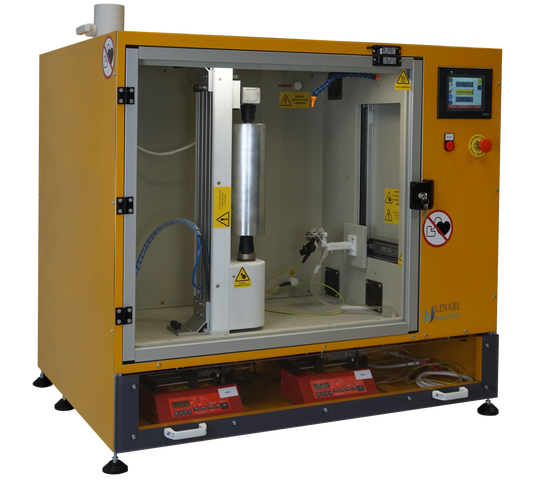
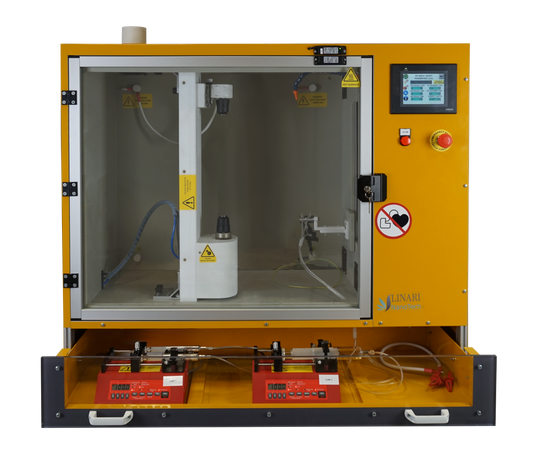
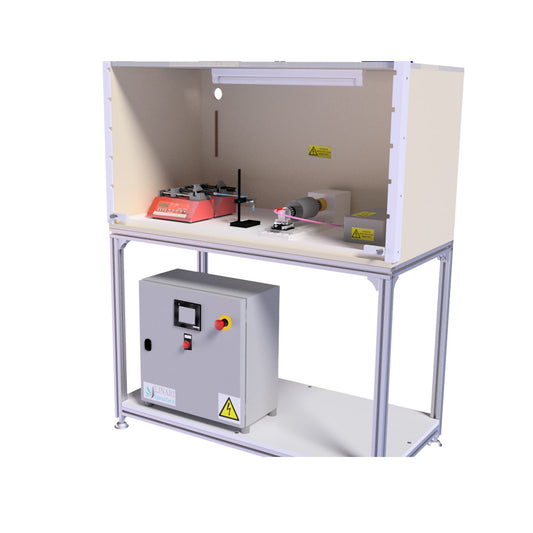
Electrospinning machines designed and built in Italy since 2003
Linari Nanotech designs and manufactures electrospinning machines in Pisa, Italy, with more than 400 installations worldwide in universities, research centers and manufacturing companies. Every system is engineered in-house — electronics, mechanics and software — and can be configured for biomedical, pharmaceutical, filtration, energy and advanced materials applications. Our portfolio also extends beyond classic electrospinning to blow spinning, melt electrospinning, yarn electrospinning and electrospray.
Compare our electrospinning machines
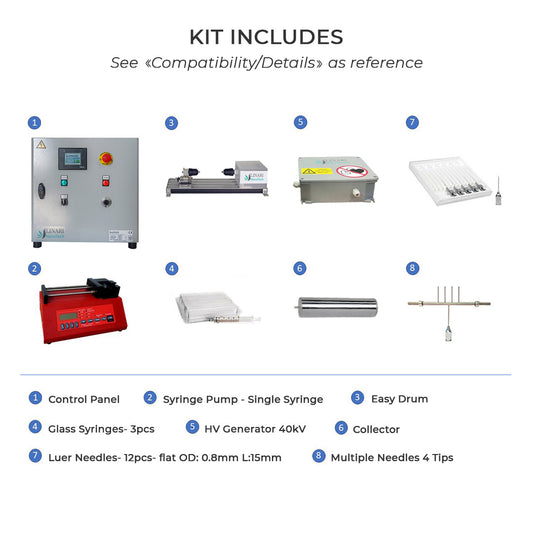
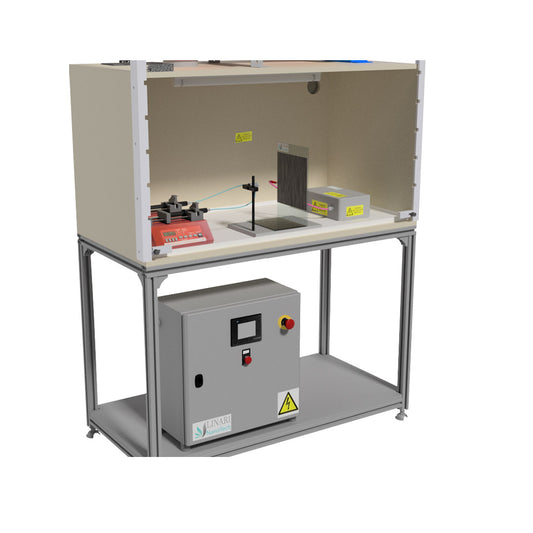
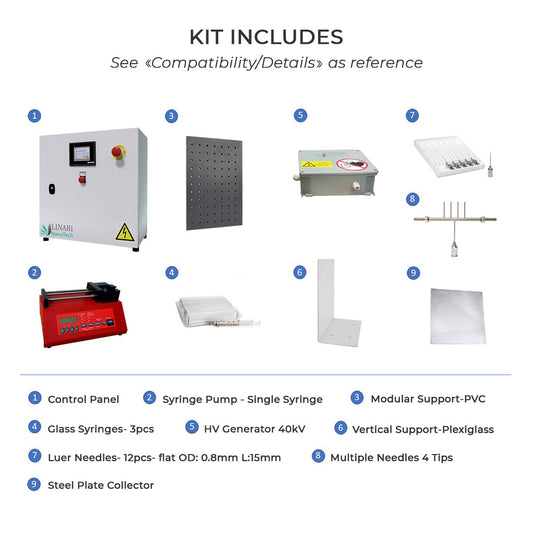
Every system below is delivered as a complete, ready-to-run machine — chamber or hood, high voltage generator, syringe pump, needles, syringes and collector included. Compare them at a glance, then open the one closest to your project.
| System |
High voltage |
Max collector |
Fiber orientation |
Distinctive capability |
Best for |
| Starter Kit — random |
40 or 60 kV |
Static plane collector |
Random |
Most accessible complete station; multi-needle emitter included |
First approach to electrospinning; non-woven mats for filtration and dressings |
| Starter Kit — aligned |
40 or 60 kV |
Ø1–100 × 150 mm rotary, up to 5000 rpm |
Random + aligned |
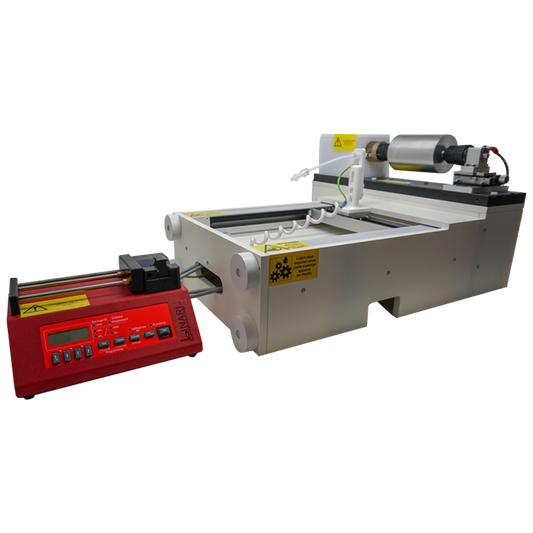
Easy Drum rotary system; up to 200 ml of solution per day |
Aligned scaffolds and tubular structures on a limited budget |
| Compact Unit |
40 kV (60 kV optional) |
Ø80 × 300 mm rotary |
Random + aligned |
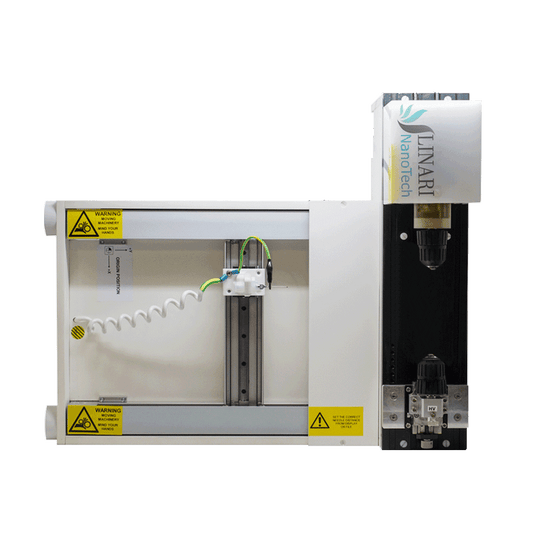
Spinneret moves while collector rotates → uniform thickness along the whole axis; chamber up to +50 °C |
Uniform membranes and tubular scaffolds in a small footprint |
| All In One |
40 kV; collector insulated, 2nd generator −40 kV → up to 80 kV bipolar |
Interchangeable flat & drum collectors |
Random + aligned |
Modular platform: roll-to-roll up to 300 mm, XY gantry, air treatment unit, Taylor cone camera and Digital Pack can be added later |
R&D groups whose requirements will grow over time |
| Gantry 3D Spin |
40 kV |
Plate collector; optional insulated drum (vertical/horizontal) |
Random + aligned |
G-code from CAD or CSV from spreadsheet; ±0.02 mm repeatability; needle distance adjustable 40–230 mm during the run |
Patterned scaffolds, melt electrospinning writing, programmed trajectories |
| RT Advanced |
2 × 60 kV, one per spinning group; collector insulated |
Ø1–250 × 500 mm, up to 5000 rpm vertical axis |
Random + aligned; tubular |
Two fully independent groups (4 pumps, needle cleaning and blow spinning each), collector as electrostatic shield; 8 materials at once; no tubes; closed-loop laser thickness control to 10 nm; 21 CFR Part 11 audit trail |
Multilayer and gradient structures; unattended production in regulated environments |
| Pure Spinner |
Up to 2 × 40 kV generators, symmetrically placed |
Ø250 × 600 mm horizontal — 0.47 m² of collecting area, the largest in our range |
Random in bulk; aligned on small collectors |
No substrate, so no release into the fibre; up to 140 needles and 8 pumps; removable collector on a wheeled support; optional blow spinning with or without high voltage |
When the nanofiber itself is the product: additives, inks, chopped fibres |
All systems: any synthetic, organic or ceramic polymer from solution; coaxial needles for core-shell fibers, multi-needle emitters, heating needle system up to 250 °C and additional collectors available as options on every machine.
Still deciding? Talk to an R&D expert and we will configure the system around your material and target output — or have our laboratory in Pisa validate your nanofiber first, before you invest.
The research behind each capability
Our Knowledge Base collects 220 peer-reviewed publications on electrospinning, each summarised with authors, affiliations and a link to the original paper — including 124 that name Linari equipment in their Methods section. Below, the studies that best explain what each machine capability is used for in practice.
Aligned fibers and tubular structures — the capability of the Starter Kit for aligned nanofibers, the Compact Unit and any system with a rotary collector:
Coaxial and core-shell fibers — available on every system with two or more pumps, using our coaxial needles:
Process control: humidity, temperature and parameters — why the RT Advanced controls atmosphere and why an external air treatment unit is offered on the All In One:
Industrial scale-up — the ground covered by the Pure Spinner and the RT Advanced:
These are independent peer-reviewed studies collected in our Knowledge Base to document the state of the art of each technique; they are not necessarily performed on Linari equipment. Browse the full publication library.
Which electrospinning machine is right for you?
Getting started — benchtop starter kits. The Electrospinning Starter Kit for random nanofibers and the Starter Kit for aligned nanofibers (with Easy Drum rotary collector) are compact 40–60 kV systems ideal for laboratories approaching nanofiber fabrication for the first time.
Research & development systems. The Compact Electrospinning Unit produces both random and aligned nanofibers with an X-Y moving spinneret; the All In One Electrospinning System is a modular 40 kV multi-collector platform that grows with your research; and the Gantry 3D Spin adds G-code XY control for near-field precision patterning.
Industrial and pilot production. The RT Advanced runs two fully independent spinning groups — 2 × 60 kV, 8 pumps, up to 8 materials at once — with closed-loop thickness control for unattended operation in regulated environments, while the Pure Spinner produces substrate-free nanofiber material in bulk on a horizontal drum of up to Ø250×600 mm. Read more about industrial scale-up.
What does an electrospinning machine include?
Every electrospinning setup is built around three main components: a high-voltage generator that creates the electric field driving the process; syringe pumps and capillary needles that extrude the polymer solution — including coaxial needles for core-shell fibers; and a collector, flat plate or rotating drum, where nanofibers deposit. Learn how the process works in our guide to electrospinning technology.
Safety and fiber quality by design
The design of our machines avoids electrostatic phenomena and interferences that may alter fiber trajectory, and special attention is dedicated to raw materials. Every chamber includes an interlock that automatically shuts down high voltage if the door is opened during operation — so you always work in a safe environment.
Modular and customized solutions
As scaffold complexity grows, your equipment can grow with it: start with a plate collector and add a rotary system for aligned nanofibers later. Our machines are designed not to limit your work, with modular upgrades, AI-assisted process tools and fully custom-engineered systems developed together with your team.
Frequently asked questions
How do I choose between a starter kit and an R&D system?
Choose a starter kit if you need to produce your first nanofiber membranes with standard polymers on a limited budget. Choose an R&D system (Compact, All In One, Gantry 3D Spin) if you need multiple collector types, precise process control, aligned fibers or multi-material spinning.
How much does an electrospinning machine cost?
Prices depend on configuration: voltage range, number of pumps, collector types and options such as climate control. Benchtop starter kits are the most accessible entry point, while industrial systems are quoted per project. Request a quote and we will configure the right system for your application and budget.
Can I upgrade my machine after purchase?
Yes. The modular design is a core principle of Linari systems: collectors, pumps, coaxial needle sets and AI process tools can be added later without replacing the base machine.
Do Linari machines support coaxial and core-shell electrospinning?
Yes — all systems with two or more syringe pumps work with our sealed and modular coaxial needles for core-shell and triaxial nanofibers.
Do you deliver, install and support internationally?
Yes. With 400+ installations across more than 70 countries, we ship from Italy and provide installation, training and after-sales support for laboratories and production sites worldwide.