
Electrospinning Starter Kit – Random Nanofibers, Multi-Material, 40–60 kV
Electrospinning Starter Kit – Random Nanofibers, Multi-Material, 40–60 kV
Shipping date: 21 Oct


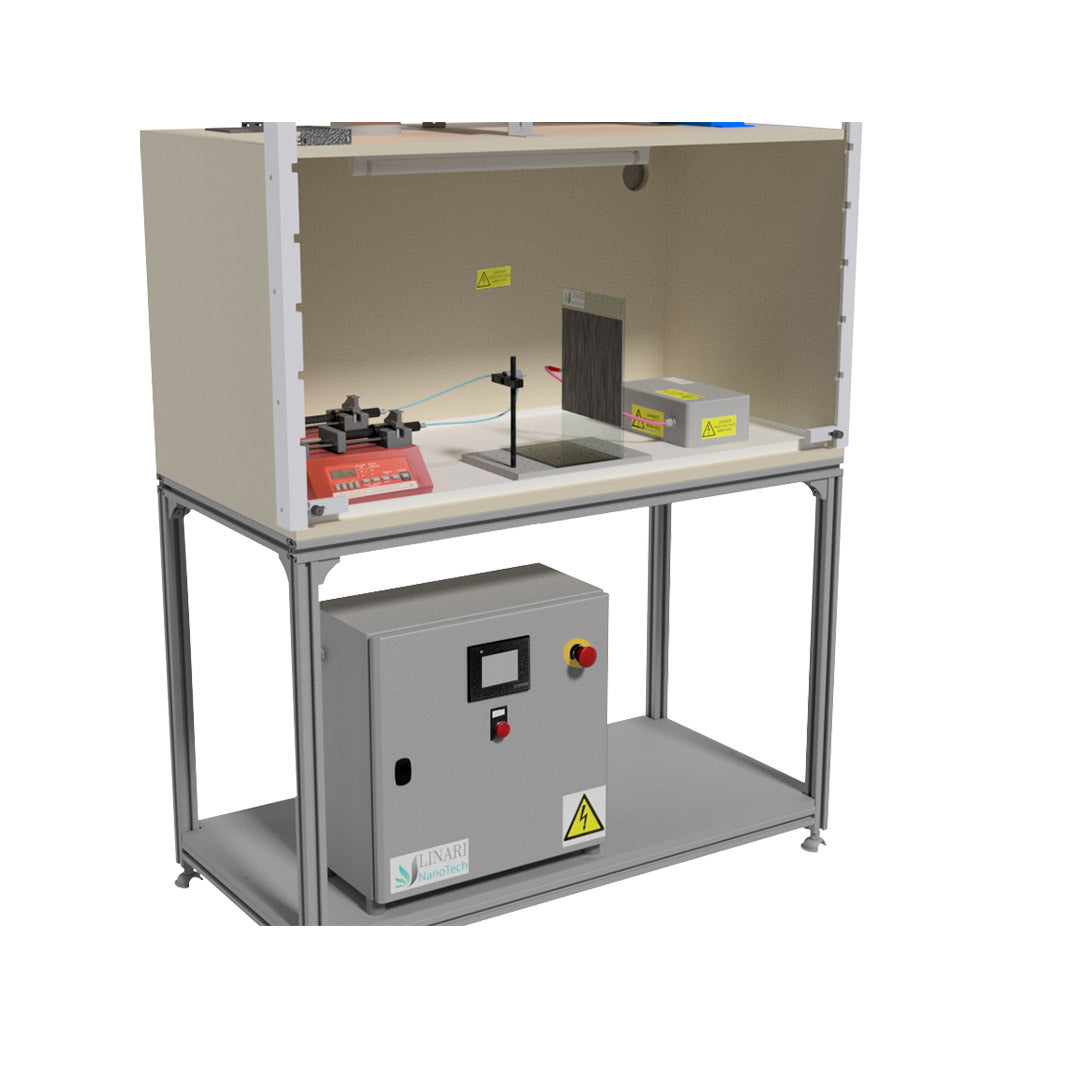
Our Starter Kit Random is suitable for first time users of electrospinning techniques or expert users who need a dedicated station to develop new materials.
THE PERFECT SOLUTION FOR YOUR ELECTROSPINNING PROCESS
Our Starter Kit guarantees high performances, remaining compact and user-friendly.
Everything you need, in one delivery
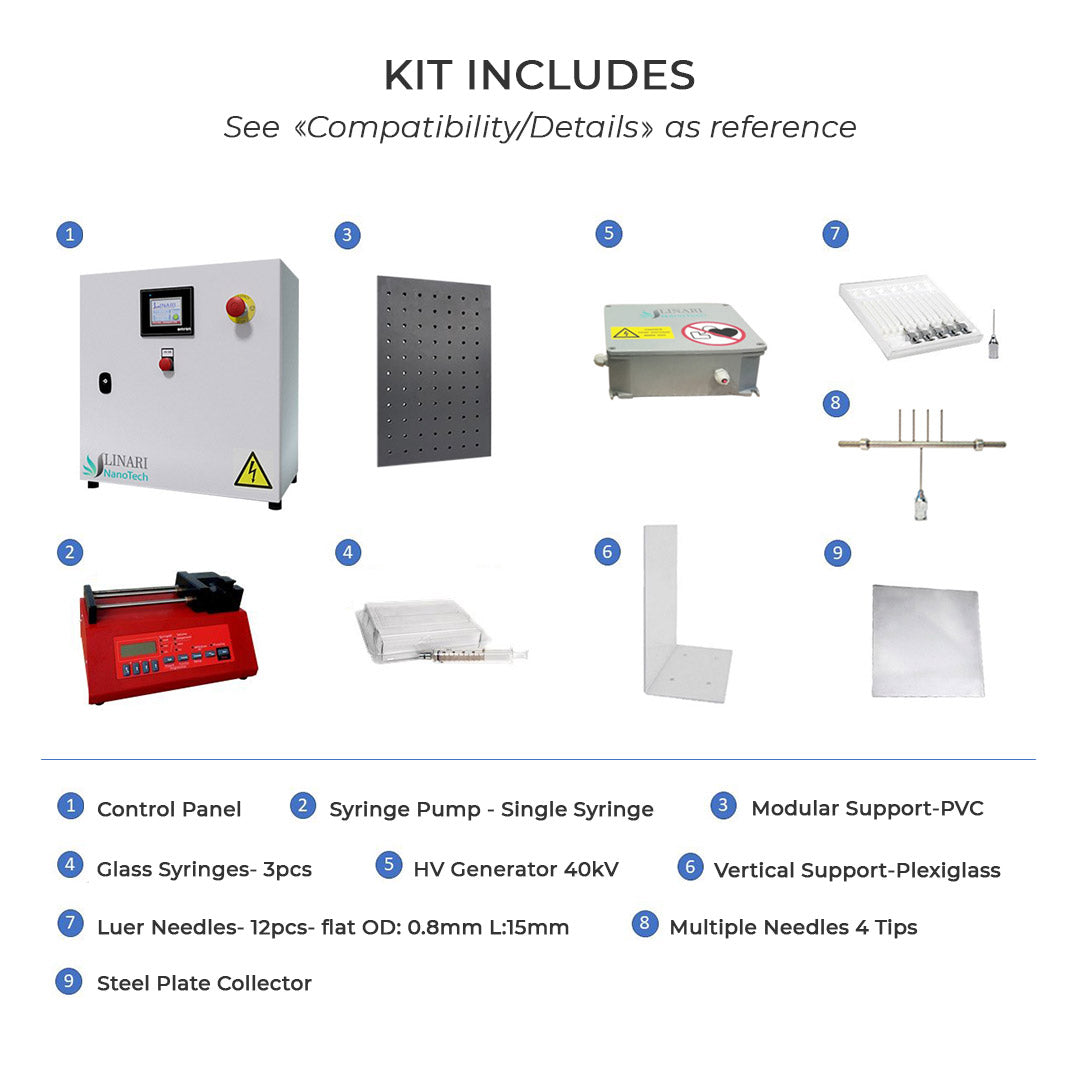
This is a complete electrospinning station, not a component to be integrated: high voltage generator, syringe pump, modular support, needles and syringes arrive together and work together from day one. You do not have to source a generator from one supplier, a pump from another and hope they match.
For a laboratory approaching electrospinning, that removes the three things that usually delay a first result: compatibility between parts, electrical safety, and knowing which parameters to start from.
WHAT ADVANTAGES DO YOU GET FROM USING THIS KIT?
You have no space limitations in the hood, so you can easily add more accessories to complement the kit.
Random nanofibers: where the non-woven structure is the point
A randomly oriented mat is not a compromise - for many applications it is exactly what is needed. The isotropic, highly porous network with very high surface-to-volume ratio is what makes electrospun nonwovens work in:
- Filtration - air and liquid filter media, where tortuous pore paths capture particles far below the fiber diameter.
- Wound dressings and scaffolds - a mat that behaves the same in every direction, mimicking the extracellular matrix.
- Drug delivery - loaded membranes with controlled release, and core-shell fibers with the optional coaxial needle kits.
- Energy and catalysis - separators, electrodes and catalyst supports where accessible surface area drives performance.
With the multiple needle emitter included as standard you can also increase deposition rate, or spin more than one solution at a time for blended mats.
WHAT MATERIALS CAN YOU ELECTROSPIN?
It is possible to electrospin any type of synthetic, organic polymer or ceramic material, starting from solutions at room temperature.
WHAT QUALITY AND QUANTITY OF NANOFIBERS DO YOU GET?
The user can create deposits of micro/nanofibers with random structure, on a static plane collector, with high reproducibility over time.
DO YOU NEED ALIGNED FIBERS INSTEAD?
This kit deposits fibers on a static collector, so the structure is randomly oriented. If your application needs fibers aligned in one direction - nerve, tendon, muscle or vascular scaffolds, anisotropic sensors and composites - or tubular structures, choose the version equipped with the rotary collection system.
SEE THE STARTER KIT FOR ALIGNED NANOFIBERS
STANDARD PRODUCTS INCLUDED
- HV Generator 40 kV or 60kV with control unit (LCD Display and Web Control).
- Modular support
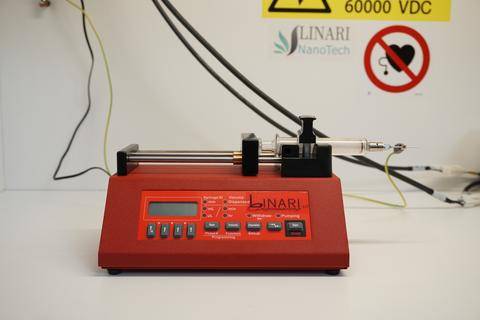
- SYRINGE PUMP WITH LOCAL CONTROL (OPTIONAL: SYRINGE PUMP SINGLE/DOUBLE CHANNEL WITH LOCAL AND REMOTE CONTROL).
- Luer Lock Needles - 12 pcs.
- Multiple Needles - 4 tips.
- Glass Syringes - 3pcs 10ml.
OPTIONAL
- Electrospinning Station Hood.
- Coaxial Needle Equipment: Sealed Coaxial Needle Kit-Coaxial Needle Kit.
- Plane collector and support.
- Heating needle system up to 250 °C for melt electrospinning.
MODEL CODES — HOW TO CITE THIS SYSTEM
The nameplate on your station carries the model code of the configuration you received. The STKIT family identifies the Electrospinning Starter Kit, followed by the voltage of the generator supplied: STKIT-40 for the 40 kV configuration, STKIT-60 for the 60 kV one. The high voltage control unit is separately labelled HVG-CONT-LCD.
If you are writing the Materials and Methods section of a paper, the correct attribution is:
Electrospinning was performed using an Electrospinning Starter Kit (STKIT-40, Linari Engineering S.r.l., Pisa, Italy).
Please let us know when you publish - we collect studies performed with our systems in our Knowledge Base.
Not sure how your material should be spun?
Describe your polymer and target fiber, and our AI assistant will suggest the process parameters to start from - solvent system, voltage, flow rate, distance and collector setup.
Which complete system fits your project?
This Starter Kit is the most accessible complete station in our range. Every system above it is also delivered ready to run - chamber, generator, pumps, needles and collectors included:
|
Starter Kit - random Complete entry point |
40 or 60 kV generator, syringe pump, modular support, single and multiple needles, glass syringes. Random nanofibers on a static collector. |
|
Starter Kit - aligned Adds the rotary system |
The same complete station with the Easy Drum rotary collector, for aligned fibers and tubular structures, up to 200 ml of solution per day. |
|
Compact Unit Uniform membranes |
The spinneret moves while the collector rotates, giving uniform thickness along a collector up to Ø80×300 mm - larger than a starter kit can take. |
|
Gantry 3D Spin Programmed precision |
G-code control of the emitter path from CAD, or CSV from a spreadsheet, with adjustable needle-collector distance during the run. |
|
All In One Modular R&D platform |
40 kV multi-collector system with optional roll-to-roll up to 300 mm, XY gantry and external air treatment unit. |
|
RT Advanced / Pilot Spinner Industrial |
Up to 8 materials at once and unattended production, or a drum collector up to Ø250×600 mm for pilot quantities. |
Not sure which one? Talk to an R&D expert and we will configure the system around your material - or have our laboratory in Pisa validate your nanofiber first.
Frequently asked questions
Is everything included to start producing nanofibers?
Yes. The kit includes the 40 kV (or optional 60 kV) high voltage generator with control unit, a syringe pump, a modular support, Luer lock needles, multiple needles with 4 tips and glass syringes. The station hood is available as an option.
What is the model code of this kit?
The Starter Kit family is coded STKIT, followed by the generator voltage: STKIT-40 for 40 kV and STKIT-60 for 60 kV. The high voltage control unit carries its own label, HVG-CONT-LCD. These are the codes to quote in the Materials and Methods section of a publication.
What is the difference from the aligned version?
This kit uses a static collector and produces randomly oriented, non-woven mats. The aligned version includes the Easy Drum rotary system, which draws the fibers along the rotation direction and also allows tubular structures.
When is a random structure the right choice?
Whenever isotropic behaviour and high porosity matter more than direction: filtration media, wound dressings, general scaffolds, drug-loaded membranes, battery separators and catalyst supports.
Can I increase the production rate?
Yes. The multiple needle emitter with 4 tips is included as standard and increases deposition rate; it also lets you spin more than one solution at the same time for blended mats.
Can I do coaxial or melt electrospinning with this kit?
Yes, as options: sealed or modular coaxial needle kits for core-shell fibers and encapsulation, and the heating needle system up to 250 °C for solvent-free melt electrospinning.
Can I add a rotary collector later?
Yes. The Easy Drum rotary system can be added to the station afterwards, which is what turns a random setup into one capable of aligned fibers.
Which materials can I electrospin?
Any synthetic, organic polymer or ceramic material, starting from solutions at room temperature.
How do I know if my material can be electrospun?
You can ask espin.ai for a starting set of process parameters, or have our laboratory in Pisa run a feasibility test on your material and characterize the fibers by SEM before you buy.
Fibres produced on Linari systems
Electron and confocal micrographs from peer-reviewed, open-access publications whose Methods section names Linari electrospinning equipment, together with images produced in our own laboratory.


Published research using the Electrospinning Starter Kit
The Linari Electrospinning Starter Kit is cited by name in 47 peer-reviewed publications indexed in Europe PMC between 2016 and 2026, in journals including Nano-Micro Letters, ACS Applied Materials & Interfaces and Biomacromolecules. The Starter Kit is our complete entry-level station (model codes STKIT-40 and STKIT-60, control unit HVG-CONT-LCD), which explains why it is the most widely cited Linari system in the literature. The application areas below are taken from the Methods sections of those papers, where the equipment is identified explicitly.
Tissue engineering and regenerative medicine
The Electrospinning Starter Kit has been used in 16 published studies on scaffolds for tendon, bone, nerve, cardiac and soft tissue regeneration.
- Electrospun Composite Fibers Containing Te-Doped Bioactive Glass Powders — Polymers, 2025
- Electrospun PVP Fibers as Carriers of Ca2+ Ions for Titanium Implants — Molecules, 2024
- Nanoclay-Doped Electrospun Nanofibers for Tissue Engineering — International Journal of Nanomedicine, 2023
- Poly(butyl cyanoacrylate) Scaffolds for Tendon Tissue Engineering — International Journal of Molecular Sciences, 2023
- Multichannel Platforms for Peripheral Nerve Injuries — Biomacromolecules, 2023
- Cerium Oxide and Chondroitin Sulfate Polyurethane Scaffold for Tendons — ACS Applied Materials & Interfaces, 2023
- Gradient Tubular Scaffold for Bone-to-Tendon Interface — Pharmaceutics, 2022
- Spermidine Crosslinked Gellan Gum Nanofibers for Nervous Tissue Injuries — International Journal of Nanomedicine, 2022
- PCL-Polyaniline Scaffold Treated with Atmospheric Plasma — Bioengineering, 2021
- Gellan-Based Composite System for Nervous Tissue Injuries — Pharmaceutics, 2021
- Smart Device for Regeneration of the Osteo-Tendon Interface — Pharmaceutics, 2021
- PCL Fiber Mats with B and Co Co-Doped Bioactive Glass Nanoparticles — Materials, 2020
- PCL/PGS Composite Fibers with Bioactive Glass Particles — Nanomaterials, 2020
- Dual-Functioning Scaffolds for Spinal Cord Injury — Marine Drugs, 2019
- Gelatin-Chondroitin Sulfate Scaffolds with Platelet Lysate — Polymers, 2018
- Mesenchymal Stem Cells and Myoblast Differentiation for Skeletal Muscle — BMC Cell Biology, 2017
Controlled drug delivery
The Electrospinning Starter Kit has been used in 8 published studies on fibres engineered to release an active compound at a defined rate or site.
- Hydrogel-Forming Nanofibres in a pH-Responsive Film for STI Prevention — International Journal of Pharmaceutics: X, 2025
- Multi-Nanodrug Delivery Systems for Transdermal/Tympanic Patches — Polymers, 2023
- Spermidine Crosslinked Gellan Gum Nanofibers for Nervous Tissue Injuries — International Journal of Nanomedicine, 2022
- Gellan-Based Composite System for Nervous Tissue Injuries — Pharmaceutics, 2021
- Composite Nanosystem for Local Treatment of Glioblastoma — Polymers, 2021
- Norfloxacin-Loaded Scaffolds: Nanocomposite vs Free Drug — Pharmaceutics, 2020
- Dual-Functioning Scaffolds for Spinal Cord Injury — Marine Drugs, 2019
- Coated Alginate-Containing Fibers for Regenerative Purposes — International Journal of Nanomedicine, 2018
Wound healing and dressings
The Electrospinning Starter Kit has been used in 7 published studies on fibrous dressings for chronic, traumatic and burn wounds.
- Protein-Based Nanofibers Doped with Selenium Nanoparticles for Wound Repair — Pharmaceutics, 2025
- PCL/Gelatin Nanofibers Loaded with Pinus radiata Bark Extracts — Polymers, 2022
- Electrospun Scaffolds in Periodontal Wound Healing — Polymers, 2021
- Chitosan-Coated PLA Nanofibres Loaded with Essential Oils — Polymers, 2021
- Electrospun Fibers Containing Bioactive Glass Particles for Wound Healing — Materials, 2020
- Halloysite- and Montmorillonite-Loaded Scaffolds for Chronic Wounds — Pharmaceutics, 2020
- Chitosan/Glycosaminoglycan Scaffolds with Silver Nanoparticles — Polymers, 2019
Antibacterial and antimicrobial materials
The Electrospinning Starter Kit has been used in 6 published studies on fibres carrying silver, copper, essential oils or antibiotics.
- Electrospun Composite Fibers Containing Te-Doped Bioactive Glass Powders — Polymers, 2025
- Chitosan-Coated PLA Nanofibres Loaded with Essential Oils — Polymers, 2021
- Electrosprayed Chitin Nanofibril / Electrospun PHA Fiber Mesh — Journal of Functional Biomaterials, 2020
- Norfloxacin-Loaded Scaffolds: Nanocomposite vs Free Drug — Pharmaceutics, 2020
- Chitosan/Glycosaminoglycan Scaffolds with Silver Nanoparticles — Polymers, 2019
- Manuka Honey as a Natural Polyelectrolyte for Nanostructured Meshes — Frontiers in Bioengineering and Biotechnology, 2019
Sustainable and bio-based materials
The Electrospinning Starter Kit has been used in 6 published studies on green solvents, biopolymers and valorisation of agri-food waste.
- A Green Method for Bacterial Cellulose Electrospinning — Polymers, 2025
- PCL/Gelatin Nanofibers Loaded with Pinus radiata Bark Extracts — Polymers, 2022
- Electrosprayed Chitin Nanofibril / Electrospun PHA Fiber Mesh — Journal of Functional Biomaterials, 2020
- Collagen/PCL Nanofibers in Green Solvent by DOE Assisted Process — Materials, 2020
- Waste Tuscan Olive Leaves as Antioxidant Source — International Journal of Molecular Sciences, 2019
- Versatile Production of PCL Fibers Using Benign Solvents — Nanomaterials, 2016
Sensors and flexible electronics
The Electrospinning Starter Kit has been used in 4 published studies on piezoelectric, strain, vibration and optical sensing elements.
- Engineered Nanofiber-Hydrogel Systems for Colorimetric Lactate Sensing from Breath — ACS Applied Materials & Interfaces, 2025
- Pullulan-Ionic Liquid Composite for Vibration Sensors — Sensors, 2024
- Piezoelectric Yield of Single Electrospun Polyacrylonitrile Fibers — Polymers, 2024
- Ultrathin Flexible TPU/Carbon Black Film Strain Sensor — Nano-Micro Letters, 2021
Energy: fuel cells, batteries and electrolysis
The Electrospinning Starter Kit has been used in 4 published studies on reinforced ionomer membranes, separators and electrode materials.
- SPPSU/SPES Membranes Reinforced with Electrospun PPSU Mats — Membranes, 2026
- Piezoelectric Yield of Single Electrospun Polyacrylonitrile Fibers — Polymers, 2024
- Hydrolytic and Mechanical Stability of Proton Exchange Membranes — Membranes, 2022
- Nanostructured, Metal-Free Electrodes for the Oxygen Reduction Reaction — Molecules, 2022
Medical device coatings
The Electrospinning Starter Kit has been used in 4 published studies on nanofibrous coatings applied to implants, meshes and consumables.
- Electrospun PVP Fibers as Carriers of Ca2+ Ions for Titanium Implants — Molecules, 2024
- Electrospun Scaffolds in Periodontal Wound Healing — Polymers, 2021
- In-vitro Characterization of a Hernia Mesh with Nanostructured Coating — Frontiers in Bioengineering and Biotechnology, 2020
- Multifunctional Coatings for Robotic Implanted Device — International Journal of Molecular Sciences, 2019
Electrospinning process control
The Electrospinning Starter Kit has been used in 3 published studies on the process itself as the object of investigation.
- Collagen/PCL Nanofibers in Green Solvent by DOE Assisted Process — Materials, 2020
- Electrospun Alginate Fibers: Mixing Two PEO Grades — Nanomaterials, 2018
- Versatile Production of PCL Fibers Using Benign Solvents — Nanomaterials, 2016
In vitro disease models
The Electrospinning Starter Kit has been used in 2 published studies on three-dimensional culture platforms replacing flat culture and animal testing.
- PCL and PLA Fiber Scaffolds for 3D Colorectal Cancer Models — International Journal of Molecular Sciences, 2023
- Bioartificial Scaffolds for In Vitro Modelling of Cardiac Fibrosis — Frontiers in Bioengineering and Biotechnology, 2022
Diagnostics and point-of-care
The Electrospinning Starter Kit has been used in 1 published study on fibres as sampling or sensing substrates for clinical analysis.
- Engineered Nanofiber-Hydrogel Systems for Colorimetric Lactate Sensing from Breath — ACS Applied Materials & Interfaces, 2025
Ceramic and metal-oxide nanofibers
The Electrospinning Starter Kit has been used in 1 published study on precursor fibres converted by calcination into inorganic nanostructures.
- Water-Mediated Conversion of BaTiO3 Nanoparticles into BaCO3 Nanorods — ACS Applied Nano Materials, 2023
