

RT MedLine – Cleanroom Electrospinning System for Medical Device Manufacturing
RT MedLine – Cleanroom Electrospinning System for Medical Device Manufacturing
RT MedLine is a cleanroom electrospinning system for medical device manufacturing: washable stainless steel structures, automatic mandrels and an anthropomorphic robotic arm, climate control precise to 10–70% RH ±2% and ambient–50 °C ±1 °C, built around a 21 CFR Part 11 audit trail and closed-loop thickness control.
It is not a laboratory instrument adapted for production. It is a production island designed for companies that manufacture scaffolds, vascular grafts and other electrospun implantable devices, and that have to prove how every unit was made.
RT MedLine is in production today, manufacturing grafts at a medical device company. Under a confidentiality agreement we cannot name the customer, but the platform is not a concept: it is running.
A clean island, not a machine in a room
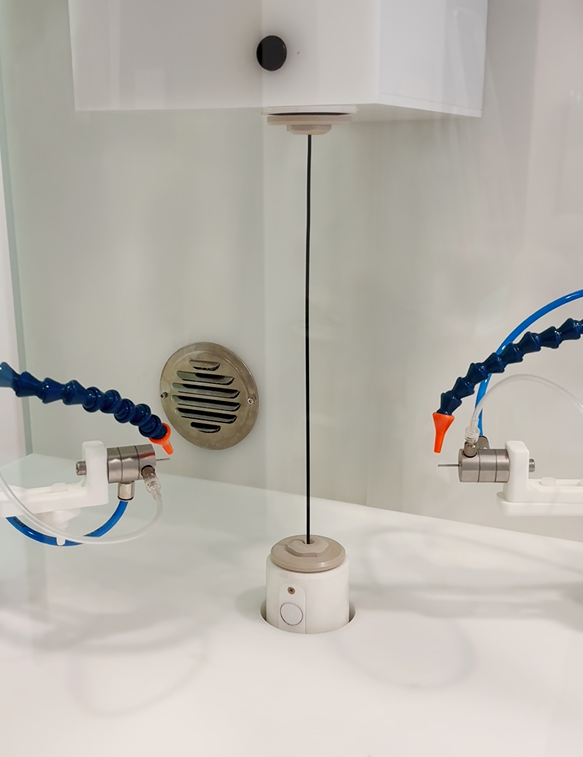
The external structures are stainless steel, designed to be washed — no painted surfaces, no crevices that survive a cleaning validation. Inside the chamber, automatic mandrels handle the tubular substrates. Outside, an anthropomorphic robotic arm loads and unloads them.
The result is a closed production cell: parts go in, finished scaffolds or grafts come out, and the operator does not reach inside between cycles. Fewer human interventions mean fewer contamination events and fewer deviations to justify to an auditor.
Two independent groups, so one device can be two materials
RT MedLine inherits the architecture of RT Advanced: two fully independent spinning groups, each with its own 60 kV generator, its own four pumps, its own automatic needle cleaning and its own blow spinning system, placed symmetrically about the collector axis — with the mandrel itself acting as an electrostatic shield between them.
For an implantable device that matters more than it does in a laboratory. A vascular graft is rarely one material: an inner layer that faces blood and an outer layer that provides mechanical strength are different polymers with different processing windows. With two independent groups, they are deposited on the same mandrel in a single run, at different voltages and different gas flows, without opening the cell to reconfigure it between layers.
Every layer transition that does not require opening the chamber is one less contamination risk and one less step to describe in a batch record.
Automation that moves the samples and the data
Inside the cell, the robotic arm handles loading and unloading. Between cells, autonomous guided vehicles (AGVs) move samples to the next step of the process — drying, characterisation, packaging — without an operator carrying trays across a controlled area. Each transfer is one less opportunity for contamination and one less manual step to describe in a procedure.
Physical automation on its own, though, only moves the paperwork somewhere else. What makes the cell useful is that the material and its record travel together: each sample is identified, the machine writes the run record against that identity, and the data flows into your systems as it is produced. Voltage, flow rates, gas flow, temperature, humidity, mandrel speed and measured thickness are logged for every unit and reconciled with the device that came out of the chamber.
The result is a digital thread from raw solution to finished device: when an auditor asks how a specific graft was made, the answer is a query, not an archive search. And because the integration is built on Alleantia technology, the cell speaks the protocols your MES and quality system already use rather than requiring a bridge built for the occasion.
Built around your process, not around our catalogue
Geometries are customised to the application: chamber dimensions, mandrel sizes and count, robot reach, AGV routing and the layout of the cell are defined with you, because a coronary graft, a nerve conduit and a hernia patch do not need the same island.
This is a configured system, specified before it is built. It starts from a conversation about the device you make, not from a datasheet.
Every unit, documented
- Named user accounts with role-based access. Every action is attributed to a person, not to a shared login.
- A complete audit trail, designed to meet 21 CFR Part 11 — parameter changes, run start and stop, alarms and interventions recorded with user, timestamp and electronic signature.
- Alarms sent by email as they occur, so an out-of-range parameter or a fault does not go unnoticed between visits.
- Full process telemetry for every run: voltage, flow rates, gas flow, temperature, humidity, mandrel speed and measured thickness.
- Qualification documentation for regulated environments, available on request.
Thickness is a release parameter, so the machine controls it
One or more laser sensors measure the deposit on the rotating mandrel in several positions during the run, with an accuracy of 10 nanometers. Deposition continues until the target thickness is reached, then stops on its own.
Measuring in more than one position also tells you whether the wall is uniform along the graft, not only how thick it is at one point. For an implantable device, that is the difference between a measurement and a specification.
Your batch records, in your systems
RT MedLine complies with the EU Data Act: free, secure, programmatic access to configuration and telemetry data, built on Alleantia technology with more than ten integration protocols. Batch records can be written straight into your MES, your validated cloud platform or your internal servers — where your quality system already lives.
Clean process, clean fibres
- No internal tubing. The syringes move with the needles, so nothing is left in a tube between runs, there is no dead volume at material change, and cross-contamination is structurally prevented rather than managed by cleaning.
- Electrically insulating chamber surfaces. Competing systems use earthed metal structures, and earthed metal near a high voltage field attracts nanofibres continuously — material that never reaches the mandrel.
- Automatic needle cleaning with timed jets of compressed gas on each group, the most common cause of an interrupted run removed.
- Climate control with solvent extraction. The external air treatment unit holds 10–70% RH to within 2% and ambient to 50 °C to within 1 °C while extracting solvent vapour, with an airflow gentle enough not to strip fibres off the mandrel.
- Inert gas flushing for oxygen-sensitive materials.
Support for a validated process
- Warranty extensions up to five years.
- Scheduled maintenance plans designed to support your regulatory obligations, not only to fix faults.
- Dedicated remote assistance module.
- Direct access to our R&D team in Pisa — the people who built the machine.
One electrospinning ecosystem, from first experiment to validated production. RT MedLine is the cleanroom configuration of the same platform that starts on All In One and scales through RT Advanced — backed by 400+ installations, 124 peer-reviewed publications and customers in 70+ countries.
Is RT MedLine the right system?
|
RT MedLine Cleanroom manufacturing |
You manufacture implantable or regulated devices, you need an automated clean cell and documented batch records. Geometry configured to your device. |
|
RT Advanced Multi-material & unmanned |
The same two-group architecture and compliance stack, in a standard laboratory or production room: 2 × 60 kV, 8 pumps, up to 8 different materials in one deposit. |
|
Pure Spinner Bulk substrate-free fibre |
When the nanofiber itself is the product rather than a device: horizontal drum up to Ø250×600 mm, 0.47 m² of collecting area, up to 140 needles. |
Not sure? Talk to an R&D expert and we will define the cell around your device and your regulatory pathway.
Frequently asked questions
Is RT MedLine already in use?
Yes. A system is in production at a medical device manufacturer, producing grafts. Under a confidentiality agreement we cannot name the customer, but we can discuss the configuration and what it took to qualify it.
Can it deposit two different materials on the same graft?
Yes, in a single run. The two spinning groups are fully independent — own generator, own four pumps, own needle cleaning, own blow spinning system — and sit symmetrically about the mandrel, which acts as an electrostatic shield between them. An inner layer and an outer layer of different polymers can therefore be deposited at different voltages and gas flows without opening the cell between layers.
Does the machine make my process GMP compliant?
No machine can do that: compliance belongs to your process and your quality system. What RT MedLine provides is the technical foundation an auditor expects — role-based user management, a 21 CFR Part 11 audit trail with electronic signature, complete process telemetry, washable stainless steel structures and qualification documentation on request.
How far can the cell be automated?
From loading to logistics. An anthropomorphic robotic arm loads and unloads the mandrels, and autonomous guided vehicles (AGVs) can move samples between the electrospinning cell and the next step of your process. Each sample keeps its identity through the chain, so the run record follows the material rather than being reconciled afterwards.
Can the geometry be customised?
Yes, and it normally is. Chamber dimensions, mandrel sizes and count, robot reach, AGV routing and cell layout are defined with you, because a coronary graft, a nerve conduit and a hernia patch do not need the same island.
What can it produce?
Tubular structures such as vascular grafts, nerve conduits and stent coatings on automatic mandrels, and flat scaffolds and patches. Any synthetic, organic polymer or ceramic material that can be electrospun from solution, plus melt electrospinning with heated needle systems and blow spinning with or without high voltage.
How is thickness controlled on a graft?
One or more laser sensors measure the deposit on the rotating mandrel in several positions during the run, with an accuracy of 10 nanometers. Deposition stops automatically when the target is reached, and multi-point measurement shows whether the wall is uniform along the length of the graft.
Can we integrate it with our MES or quality system?
Yes, and free of charge. RT MedLine complies with the EU Data Act: configuration and telemetry data are available through secure programmatic access, built on Alleantia technology with more than ten integration protocols.
Share
Lead time: 12–16 weeks from order confirmation. Built to order and configured to your application — request a quote for current availability.
View full details