
Fibres produced on Linari systems
Electron and confocal micrographs from peer-reviewed, open-access publications whose Methods section names Linari electrospinning equipment, together with images produced in our own laboratory.


Published research using the High Voltage Generator
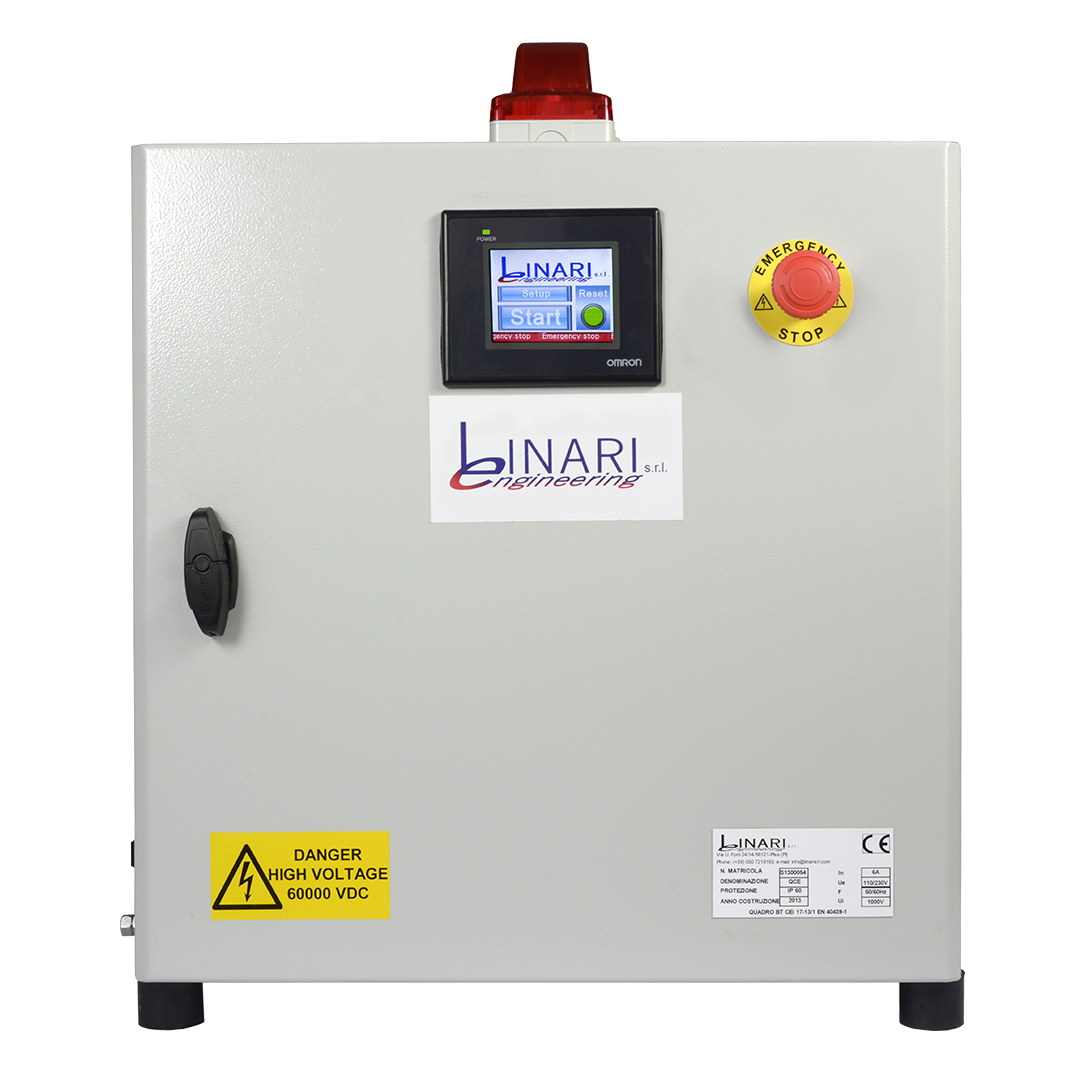
The Linari High Voltage Generator is cited by name in 25 peer-reviewed publications indexed in Europe PMC between 2018 and 2026, in journals including ACS Applied Materials & Interfaces, Macromolecular Bioscience and ACS Applied Polymer Materials. Our high voltage units are quoted in the literature under the model codes HVG-CONT-LCD, HVG-P60-R-EU and QCHV-M40, since the control unit is the part carrying the visible nameplate in the laboratory. The application areas below are taken from the Methods sections of those papers, where the equipment is identified explicitly.
Antibacterial and antimicrobial materials
The High Voltage Generator has been used in 5 published studies on fibres carrying silver, copper, essential oils or antibiotics.
- Electrospun Composite Fibers Containing Te-Doped Bioactive Glass Powders — Polymers, 2025
- Multifunctional Electrospun Materials from PVA/Chitosan and Polylactide — Polymers, 2025
- In Vitro Assessment of Electrospun PVP+AgNPs Scaffolds — International Journal of Molecular Sciences, 2025
- Chitosan-Coated PLA Nanofibres Loaded with Essential Oils — Polymers, 2021
- Norfloxacin-Loaded Scaffolds: Nanocomposite vs Free Drug — Pharmaceutics, 2020
Sensors and flexible electronics
The High Voltage Generator has been used in 5 published studies on piezoelectric, strain, vibration and optical sensing elements.
- Engineered Nanofiber-Hydrogel Systems for Colorimetric Lactate Sensing from Breath — ACS Applied Materials & Interfaces, 2025
- Pullulan-Ionic Liquid Composite for Vibration Sensors — Sensors, 2024
- Piezoelectric Yield of Single Electrospun Polyacrylonitrile Fibers — Polymers, 2024
- Local Piezoelectric Response of Polymer/Ceramic Nanocomposite Fibers — Polymers, 2022
- Electrical and Mechanical Performance of Highly Oriented Conductive Nanofibers — International Journal of Molecular Sciences, 2021
Energy: fuel cells, batteries and electrolysis
The High Voltage Generator has been used in 5 published studies on reinforced ionomer membranes, separators and electrode materials.
- SPPSU/SPES Membranes Reinforced with Electrospun PPSU Mats — Membranes, 2026
- Piezoelectric Yield of Single Electrospun Polyacrylonitrile Fibers — Polymers, 2024
- Cellulose Nanocrystals in Separators for Lithium-Ion Batteries — ACS Applied Polymer Materials, 2023
- Local Piezoelectric Response of Polymer/Ceramic Nanocomposite Fibers — Polymers, 2022
- Hydrolytic and Mechanical Stability of Proton Exchange Membranes — Membranes, 2022
Tissue engineering and regenerative medicine
The High Voltage Generator has been used in 4 published studies on scaffolds for tendon, bone, nerve, cardiac and soft tissue regeneration.
- Electrospun Composite Fibers Containing Te-Doped Bioactive Glass Powders — Polymers, 2025
- Electrospun PVP Fibers as Carriers of Ca2+ Ions for Titanium Implants — Molecules, 2024
- Electrospun PHBHV/Olive Leaf Extract Fiber Meshes — Molecules, 2022
- Influence of Nanofiber Orientation on Electrospun Chitosan Mats — Journal of Healthcare Engineering, 2018
Wound healing and dressings
The High Voltage Generator has been used in 4 published studies on fibrous dressings for chronic, traumatic and burn wounds.
- Multifunctional Electrospun Materials from PVA/Chitosan and Polylactide — Polymers, 2025
- In Vitro Assessment of Electrospun PVP+AgNPs Scaffolds — International Journal of Molecular Sciences, 2025
- Electrospun Scaffolds in Periodontal Wound Healing — Polymers, 2021
- Chitosan-Coated PLA Nanofibres Loaded with Essential Oils — Polymers, 2021
Sustainable and bio-based materials
The High Voltage Generator has been used in 3 published studies on green solvents, biopolymers and valorisation of agri-food waste.
- A Green Method for Bacterial Cellulose Electrospinning — Polymers, 2025
- Electrospun PHBHV/Olive Leaf Extract Fiber Meshes — Molecules, 2022
- Waste Tuscan Olive Leaves as Antioxidant Source — International Journal of Molecular Sciences, 2019
Medical device coatings
The High Voltage Generator has been used in 3 published studies on nanofibrous coatings applied to implants, meshes and consumables.
- Electrospun PVP Fibers as Carriers of Ca2+ Ions for Titanium Implants — Molecules, 2024
- Electrospun Scaffolds in Periodontal Wound Healing — Polymers, 2021
- Multifunctional Coatings for Robotic Implanted Device — International Journal of Molecular Sciences, 2019
Electrospinning process control
The High Voltage Generator has been used in 3 published studies on the process itself as the object of investigation.
- Size-Dependent Elastic Modulus of Electrospun PCL Nanofibers — Macromolecular Bioscience, 2025
- Core/Double-Sheath Composite Fibers from PEO, PLLA and Beeswax — Polymers, 2022
- Influence of Nanofiber Orientation on Electrospun Chitosan Mats — Journal of Healthcare Engineering, 2018
Controlled drug delivery
The High Voltage Generator has been used in 2 published studies on fibres engineered to release an active compound at a defined rate or site.
- Surface Engineering of Electrospun PLA Fibers via Polyelectrolyte Complexes — Polymers, 2026
- Norfloxacin-Loaded Scaffolds: Nanocomposite vs Free Drug — Pharmaceutics, 2020
In vitro disease models
The High Voltage Generator has been used in 1 published study on three-dimensional culture platforms replacing flat culture and animal testing.
- Transparent Cellulose Acetate Scaffolds for Blood-Brain Barrier Models — Frontiers in Bioengineering and Biotechnology, 2021
Diagnostics and point-of-care
The High Voltage Generator has been used in 1 published study on fibres as sampling or sensing substrates for clinical analysis.
- Engineered Nanofiber-Hydrogel Systems for Colorimetric Lactate Sensing from Breath — ACS Applied Materials & Interfaces, 2025
Biotechnology and live cells
The High Voltage Generator has been used in 1 published study on encapsulation of viable microorganisms.
- Effects of Electrospinning on the Viability of Lactic Acid Bacteria — Pharmaceutics, 2019
